










Key Points at a Glance
- Easier access to ePA and e-prescription through digital identification via smartphone
- Activate Health ID quickly and securely, even without an eID PIN
- More digital participation for EU citizens as well as GKV and PKV insured persons
Table of Contents
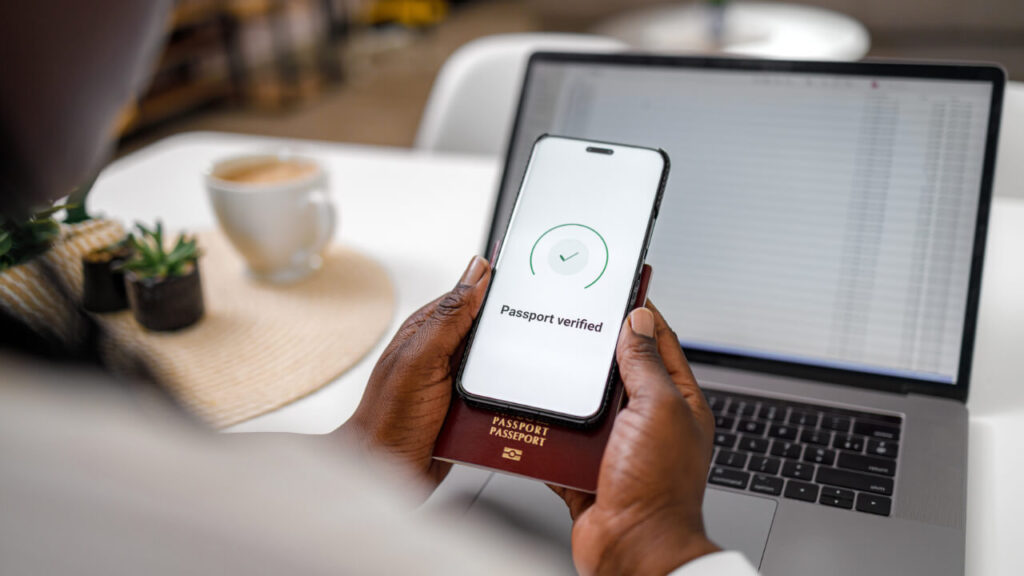
Woman with smartphone on laptop using ePass for GKV and PKV
Digital identity (Health ID) is the foundation for modern healthcare. It is the key to the electronic patient record (ePA) and the e-prescription. However, access has often been complicated until now, especially for users who do not have a German ID card with an activated online function (eID) or do not have their PIN at hand.
This is precisely where the Nect Ident with ePass procedure comes in. By combining video identification, reading the NFC chip in the passport or ID card (ePass), and biometric matching, it creates a highly secure and intuitive alternative.
Why is the ePass procedure so important?
The relevance of the procedure can be attributed to two central points:
- Inclusion of international citizens: Around five million EU citizens and 12.4 million people live in Germany who do not possess a German eID. The Nect procedure enables this large group to securely access the German telematics infrastructure (TI) digitally for the first time.
- Overcoming the PIN hurdle: The use of the German eID often fails due to a missing or forgotten PIN. The ePass procedure offers a smoother process here that does not require a PIN. Instead of “knowledge” (PIN), it uses “biometrics” (facial matching) as a second security factor.
So, what specifically changes for GKV and PKV insured persons?
The Nect Ident with ePass procedure serves to activate the Health ID or to confirm identity for the PIN issuance of the electronic health card (eGK).
For Statutory Insured Persons (GKV)
| Use Case | Traditional Method | Alternative with Nect ePass |
|---|---|---|
| eGK PIN Issuance | Identification via eID or complicated procedures, then PIN sent by mail. | Use of Nect Ident in the health insurance app for identification. |
| Health ID Creation | Identification via the eGK with PIN or eID. | Secure activation of the Health ID in the health insurance app. |
| Online Service Portal | Repeated, time-consuming verification each time. | Reuse of an already verified identity from the Nect Wallet. |
GKV Conclusion: Nect Ident offers a simpler and faster way to obtain the necessary eGK PIN and activate the Health ID. This is a crucial factor, as the eGK with PIN is the standard for many ePA accesses in the GKV.
For Private Insured Persons (PKV)
| What Changes | Before (Status Quo) | New with Nect ePass |
|---|---|---|
| Identity Verification | Often complicated procedures, possibly Post-Ident. | Quick & easy via app with ID chip and selfie video. |
| Access to ePA/e-prescription | Only via the Health ID, which was cumbersome to set up. | Easy activation of the Health ID in the PKV app. |
| Card Insertion in Pharmacy | Not possible. | Remains impossible. Redemption continues digitally via app or paper printout. |
PKV Conclusion: Nect Ident solves the fundamental identification problem of PKV and thus creates barrier-free, digital access to ePA and e-prescription for the first time.

Concrete Use Cases: What is now possible
1. Approval for eGK PIN issuance (eGK authorization)
The process by which the health insurance company sends the PIN for the eGK (for GKV). The identification of the person as the rightful cardholder now takes place simply via Nect Ident.
2. Identity confirmation for the Online Service Portal (OGS)
Insured persons can use the digital services (e.g., address changes, applications) of their health insurance company via a secure, reusable digital identity (from the Nect Wallet).
3. Approval for Health ID creation The most important step: This procedure enables the creation of the cardless, digital identity (Health ID). This is the basis for:
- Use of the ePA app: Access to findings and doctor’s letters.
- Use of the e-prescription app: Digital redemption of prescriptions.
With a high success rate of over 96 percent in verification, the ePass procedure ensures that digital health no longer fails due to technical hurdles, but is accessible to almost everyone in Germany.
For privately insured persons, identification via Nect Ident with ePass opens up new possibilities for accessing digital health applications. It specifically addresses structural differences to statutory health insurance and facilitates the use of the telematics infrastructure without a physical health card.
Identification is carried out completely digitally via smartphone and electronic ID document. Personal legitimation or additional hardware is not required. This significantly simplifies and accelerates the entry into digital health services.
A central application area is the establishment of a Health ID. For PKV insured persons, this takes on the function of a secure digital access key to telematics infrastructure applications, as an electronic health card is generally not used in PKV. The Health ID thus forms the basis for the use of the e-prescription and, prospectively, the electronic patient record (ePA).
For insured persons, the following effects result in particular:
PKV insured persons gain digital access to health applications via Nect Ident with ePass, without the need for a physical card. Furthermore, they can conveniently use the e-prescription via apps, retrieve prescriptions, and forward them directly to pharmacies. At the same time, paper prescriptions and associated analog transfer processes are eliminated. Another advantage is the nationwide standardized access, which works independently of the respective private health insurance company.
The ePass procedure meets high security and data protection requirements. The identity verification combines reading the NFC chip of the ID document with biometric procedures and ensures that only clearly verified persons can access sensitive health data. Overall, Nect Ident with ePass contributes to standardizing digital health processes for PKV insured persons and reducing existing access barriers compared to the already established solutions in the GKV sector.