


















In an increasingly digitalized world, where online transactions and business are becoming more and more common, customer identification is of crucial importance for companies.
Find out how companies identify customers and can optimize the customer identification process – KYC.
Key Points at a Glance
- The retirement provision account (AVD) starts in 2027 and brings insurers, banks and neobrokers into direct competition.
- KYC and identification are becoming a key factor for conversion, customer experience and compliance.
- Those who optimize digital completion processes early on secure competitive advantages for the market launch.
Table of Contents
What does the abbreviation KYC stand for?
Definition: What is KYC and why is it important?
When was KYC introduced?
The importance of Know Your Customer for companies
What does the Money Laundering Act say about KYC? When must the check be carried out?
Excerpt from the law and explanation
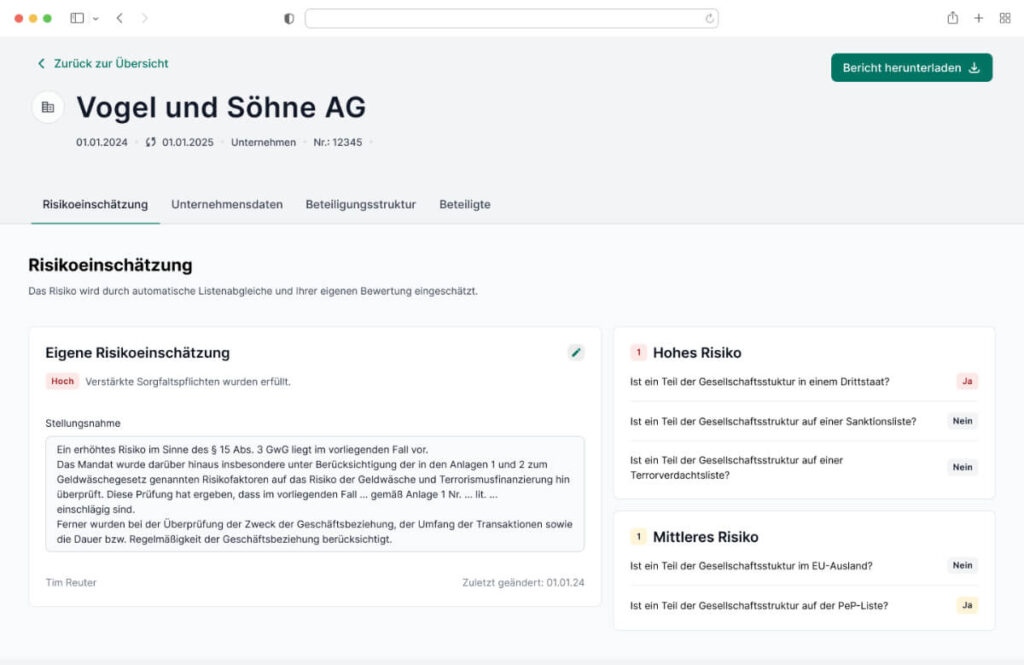
Know Your Customer is not a term that appears in the Money Laundering Act. The GwG refers to the “general due diligence obligations”. As this term is very cumbersome, the term “Know Your Customer” is often used instead. The general due diligence obligations must be applied by all obliged entities before a business relationship is established. This is regulated in Section 10 (1) GwG :
“(1) The general due diligence obligations are:
the identification of the contracting party and, where applicable, the person acting on their behalf in accordance with Section 11 (4) and Section 12 (1) and (2), as well as checking whether the person acting on behalf of the contracting party is authorized to do so,
clarifying whether the contracting party is acting for a beneficial owner and, if so, identifying the beneficial owner in accordance with Section 11 (5) and Section 12 (3) and (4); this includes, in cases where the contracting party is not a natural person, the obligation to ascertain the ownership and control structure of the contracting party by appropriate means,
obtaining and assessing information on the purpose and intended nature of the business relationship, insofar as this information is not already unequivocally apparent from the business relationship in the individual case,
determining, using appropriate risk-based procedures, whether the contracting party or the beneficial owner is a politically exposed person, a family member or a person known to be closely associated, and
the ongoing monitoring of the business relationship, including the transactions carried out in the course of it, to ensure that these transactions are consistent
with the documents and information available to the obliged entity about the contracting party and, where applicable, about the beneficial owner, about their business activities and customer profile and,
where necessary, with the information available to the obliged entity about the origin of the assets;
as part of the ongoing monitoring, obliged entities must ensure that the respective documents, data or information are updated at appropriate intervals, taking into account the respective risk.”
Who is obliged to carry out KYC checks?
Compliance with KYC regulations is of great importance, in particular for obliged entities under the Money Laundering Act.
For example, these are:
- Banks
- Insurers
- Lawyers
- Notaries
- Tax advisors
- Dealers in goods
- Real estate agents
These companies are legally obliged to carry out KYC procedures to ensure that they do not do business with individuals or organizations involved in illegal activities. By implementing effective KYC measures, obliged entities can strengthen customer trust and minimize the risk of financial losses due to fraud or money laundering.
In addition, KYC can also be important in other industries. For example, online platforms that offer payment processing services must implement KYC procedures to ensure that their customers carry out legitimate transactions.
What requirements must be met?
The minimum requirements of the general due diligence obligations under the Money Laundering Act (GwG) can be summarized as follows:
- Identification of contracting parties
- Identification of the beneficial owner
- Risk assessment
- Documentation
- Training and awareness-raising
- Reporting suspicious cases
How does KYC affect the "crypto sector"?
Challenges and solutions in the KYC process
Although KYC is of great importance, there are also some challenges that companies face.
However, carrying out KYC procedures can also be associated with challenges for companies. Collecting and verifying proof of identity requires time and resources. In addition, companies must ensure that they comply with data protection regulations and adequately protect their customers’ sensitive information. Implementing automated KYC systems can help companies make the process more efficient and cost-effective.
Common challenges in customer verification
Strategies for improving the KYC process
To optimize the KYC process, companies can use technologies such as artificial intelligence and machine learning. These technologies can help identify fraud risks and make the overall process more efficient and accurate.
Overall, KYC is of crucial importance for companies to minimize the risk of fraud and money laundering and to ensure compliance with regulations. By using technology and implementing effective strategies, companies can improve the KYC process while identifying their customers better.
How does Nect help?
The different stages of the KYC process
1. CIP Customer Identification Program or customer acceptance policy
2. CDD Customer Due Diligence
3. EDD Enhanced Due Diligence
The role of Know Your Customer in risk management
KYC and fraud prevention
By verifying the identity of their customers and assessing potential risks, companies can detect and prevent potentially fraudulent transactions. This helps them minimize financial losses and maintain customer trust.
Fraud is a widespread problem that can cause companies significant financial damage. By implementing an effective KYC process, companies can detect suspicious activities early and take appropriate measures to prevent fraud. This includes verifying customers’ identity and creditworthiness, analyzing transaction patterns and using technologies such as artificial intelligence to identify suspicious activities.
In addition, KYC enables companies to better understand their customers and analyze their behavior. By collecting and analyzing data, companies can identify patterns and trends that could indicate fraudulent activities. This enables them to take proactive measures and combat fraud effectively.