

















Key Points at a Glance
- Money laundering = illegal money is introduced into the legal financial cycle in order to disguise its origin
- The three phases of money laundering are placement, layering, and integration.
- Money laundering, attempted money laundering, and aiding and abetting money laundering are all criminally prosecuted.
Table of Contents
Definition: What is money laundering?
The three phases of money laundering: The typical process
There are various methods and types used to launder money. Two commonly used methods are layering and integration. In the first phase, the money is placed into the economic cycle:
Phase 1 "Placement": The money is placed into the economic cycle
In this phase, an attempt is made to introduce the money into the economic cycle. Restaurants are frequently used for this purpose. The restaurant generates little actual revenue, but the owner reports high sales to the tax authorities.
In addition, shell companies are set up into which the money is invested. This makes money flows less transparent.
Another method for introducing illegally obtained money is depositing small amounts of cash into many different accounts, also known as “smurfing“. Banks try to counteract this by reporting such suspicious activity.
In addition to the methods already mentioned for placing money, criminals also use “structuring”. Here, luxury goods such as precious metals, jewelry, watches, art, or cars are purchased with cash. These goods are often then sold abroad at a later date.
Phase 2 "Layering": The process of concealment
During layering, illegal funds are split across multiple transactions or spread over various accounts in order to conceal a clear link to the illegal activity. This can make it more difficult for investigating authorities to identify the actual money laundering process.
Layering is an extremely sophisticated method of laundering money. The illegal money is transferred in several steps through various financial institutions or countries. This process allows money launderers to cover the tracks of the illegal origin and disguise the source of the money.
An example of layering is splitting large sums of money into smaller amounts, which are then moved individually through various accounts or transactions. This makes it more difficult to trace the flow of money and detect its illegal origin.
Phase 3 "Integration": Introducing "clean" money into the economy
During integration, the “laundered” money is invested in legal economic activities, such as real estate or businesses. These “clean” investments serve to legitimize the illegal money while also generating profits.
By purchasing real estate, money launderers can convert their money into an asset that is not as easily traceable as cash.
Another example of integration is the establishment of shell companies that claim to conduct legitimate business. These companies can operate in various sectors, such as real estate, hospitality, or services.
When is money laundering a criminal offense?
What counts as attempted money laundering?
What constitutes aiding and abetting money laundering?
What counts as negligent or unwitting money laundering?
Unwitting money laundering occurs when someone unknowingly uses or introduces funds into the legal financial cycle without being aware of their illegal origin. In some cases, this can be used as a defense strategy to avoid criminal prosecution. However, it is important to note that the burden of proof often lies with the defendant to demonstrate that they genuinely acted unknowingly.
Negligent money laundering refers to cases in which someone has not exercised sufficient care or has neglected their duty of diligence to ensure that the funds they are working with are legal. This can lead to criminal prosecution, even if the person did not intentionally launder money. It underscores the importance of carefully reviewing and checking financial transactions in order to prevent money laundering.
What penalties can be expected?
In the past, there have been convictions resulting in prison sentences of three to five years. In particularly severe cases, up to ten years. This is set out in Section 261 of the German Criminal Code – StGB.
Can money laundering also be punished with fines?
When does money laundering become time-barred?
What is a predicate offense in relation to money laundering?
Money Laundering Prevention & Combating
The role of obligated entities under the AMLA - Know Your Customer
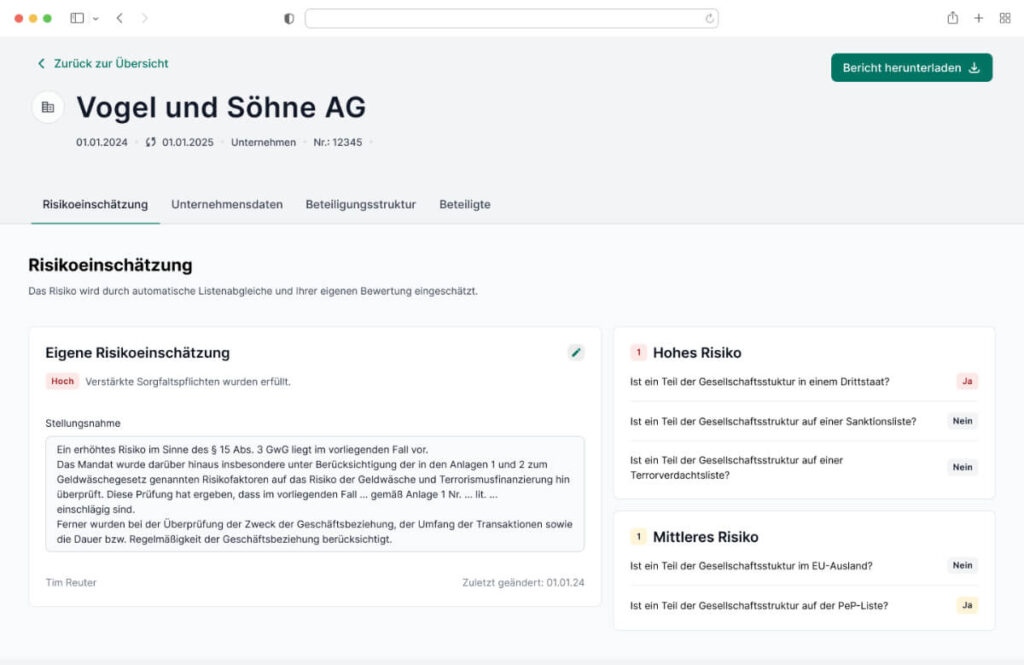
Obligated entities play an important role in preventing money laundering. They must implement effective internal control systems in order to detect suspicious transactions and report such cases to the authorities. This includes verifying customer identity, screening transactions, and assessing customer risk. This process is known as Know Your Customer – or KYC for short.
Among those required to carry out identification checks are banks, insurers, lawyers, notaries, tax advisors, goods dealers, and real estate agents.
Technological solutions for combating money laundering
New technologies such as artificial intelligence and machine learning can help financial institutions to better detect and prevent money laundering. By analyzing large volumes of data, suspicious patterns can be identified and reported. Integrating these technologies into existing systems is an important step toward effectively combating money laundering.
How does Nect help?
An example scenario - this is a case of money laundering
Suspicion of money laundering - what should I do?
When is a suspicious activity report for money laundering appropriate? Is there a reporting obligation?
- Cash-intensive businesses
- Unusual transaction patterns
- Concealment of identity
- Business conducted through third parties
- Business partners located in high-risk countries
Where do I report the suspicion?
Customs authorities use the Financial Intelligence Unit (FIU) to analyze suspicious activity reports. Reports can easily be filed online via the goAML portal.
Which authority reviews, monitors, and combats money laundering?
The Federal Financial Supervisory Authority (BaFin) is responsible for overseeing entities obligated under the AMLA, prevention systems, and suspicious activity reporting. Financial institutions are regularly reviewed to ensure that all applicable regulations and laws are being properly applied. Through ongoing updates to its regulations, BaFin continues to tighten the fight against money laundering.
What happens after a suspicious activity report is filed?
As soon as a suspicious activity report is received by the Financial Intelligence Unit (FIU), it is analyzed. If there are indeed irregularities, the case is handed over to law enforcement. This is where enforcement action by the police and public prosecutor’s office begins.
Legal regulations against money laundering - the Anti-Money Laundering Act & more
International laws and regulations
The Anti-Money Laundering Act
The Anti-Money Laundering Act is a legal instrument designed to require financial institutions and businesses to implement strict measures for the prevention and combating of money laundering and terrorist financing.
This law sets out comprehensive requirements for identifying and monitoring customers in order to ensure that financial transactions are not misused for illegal purposes, and it obligates the affected institutions to report suspicious transactions to the competent authorities.
The Anti-Money Laundering Act is part of international efforts to curb money laundering and aims to protect the integrity of the financial system and prevent the financing of criminal activities. Violations of this law can result in significant criminal and financial consequences.