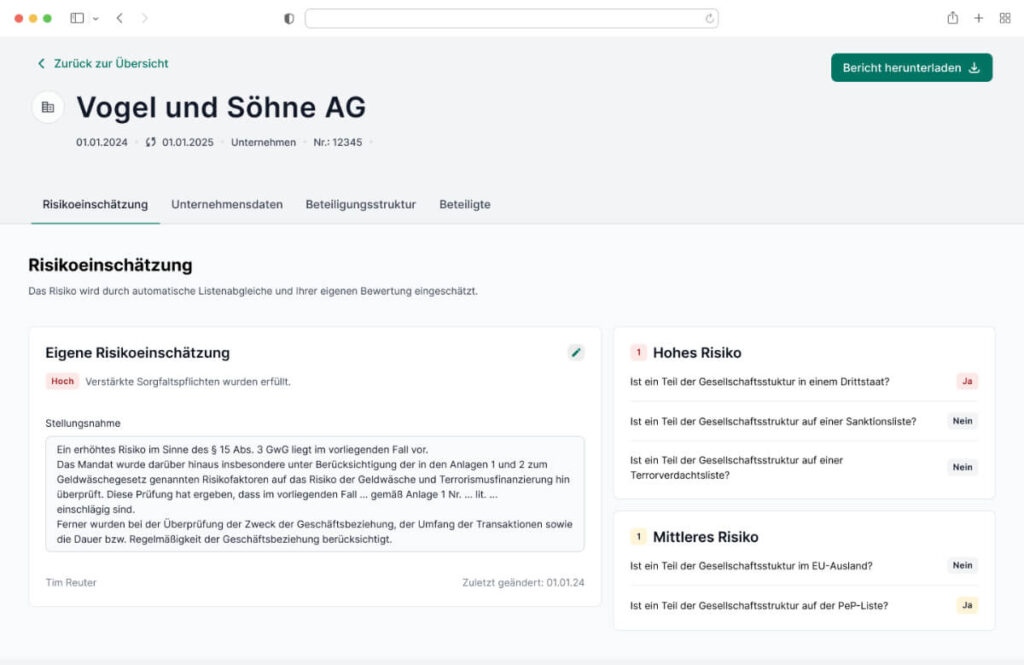


















Sanctions screening is a crucial aspect in the fight against terrorist financing and money laundering and in companies’ compliance strategy worldwide. In view of increasing globalisation and stricter international regulations, it is essential for companies to address the topic of sanctions comprehensively. The Anti-Money Laundering Act requires financial institutions, auditors and others to carry out sanctions screening of their customers. This article provides an in-depth insight into the world of sanctions, their screening, and the associated challenges.
Key Points at a Glance
- Importance of sanctions screening: Sanctions screening is crucial in the fight against terrorist financing and money laundering and is also a central component of companies’ compliance strategy to avoid legal risks and penalties.
- Types of sanctions and their administration: Sanctions range from economic and military to political measures, issued and administered by major sanctions bodies such as the United Nations, the European Union, the US and the United Kingdom.
- Sanctions screening process: Conducting sanctions screening requires several phases, including collecting relevant data, verifying it, screening against sanctions lists, analysing potential matches, documenting findings, and continuous monitoring to ensure compliance.
Table of contents
Definition: The term “sanctions”
Sanctions are an instrument of international policy designed to promote security, peace, and compliance with international norms and laws. They can be economic, military or political in nature and aim to bring about changes in behaviour by the sanctioned parties. The complexity and diversity of sanctions make careful monitoring and analysis by companies necessary to ensure compliance and avoid risks.
Types of sanctions and sanctions lists
The range of sanctions is broad and includes, among other things, economic sanctions affecting trade in goods, services and technologies, as well as financial sanctions that have a direct impact on transactions and capital flows. Sanctions lists are dynamic instruments that are updated regularly and contain the names of individuals, companies, organisations and countries with which certain types of business relationships are prohibited or restricted. It is important to know that sanctions lists are always publicly accessible.
All types of sanctions issued by sanctions bodies of states and allies:
- Explicit sanctions: Individuals, companies and states
- Narrative and implicit sanctions: Individuals, companies and states that are connected to sanctioned sectors.
- Sectoral sanctions: Specific areas within an economy.
- Comprehensive sanctions: Sanctions against entire states. For example, Iran.
- Targeted sanctions: An attempt is made to obstruct individual parts of an economy. This includes individuals and companies.
Sanctions are developed and issued by various “sanctions bodies” of states and allies. The most important are listed below:
- United Nations (UN): The UN imposes sanctions through the Security Council, which is responsible for maintaining international peace and security. UN sanctions can be imposed on countries, individuals, companies or organisations to resolve conflicts, restore peace and enforce international law.
- European Union (EU): The European External Action Service (EEAS) is responsible for the list of all natural and legal persons. These sanctions are often designed to support the EU’s foreign and security policy, counter human rights violations, and promote democracy and the rule of law.
- United States (USA): The USA has several sanctions programmes administered by the Department of the Treasury, in particular the Office of Foreign Assets Control (OFAC). These sanctions target countries, terrorism, drug trafficking, human rights violations and other threats to US national security and foreign policy.
- United Kingdom (UK): After Brexit, the United Kingdom began developing and implementing its own sanctions regime. These are enforced by the Office for Financial Sanctions Implementation (OFSI).
What should be considered in sanctions screening?
When must it be carried out?
Sanctions screenings are important not only when initiating new business relationships, but also for existing partnerships and as part of ongoing risk management. The international situation and the corresponding lists can change quickly, which makes continuous monitoring and assessment necessary.
The role of identifying politically exposed persons
Adverse media: The impact on sanctions screening
Implementing sanctions screening
Phase 1: Collection
In the initial phase, the process focuses on collecting essential information required for matching against sanctions lists. This generally relates to data on customers, potential business partners, and transaction details. The information collected typically includes names, residential addresses, dates of birth, nationalities and other key details.
Phase 2: Verification
After data collection, the essential phase of verifying it follows to ensure its accuracy. In this context, the collected information is typically compared with additional data sources, such as identification documents, commercial registers or information from external data providers. The main objective of this phase is to confirm the authenticity of the data before it is used as part of sanctions screening.
Phase 3: Screening
Once data collection and verification are complete, the screening phase begins. Special sanctions screening software is used to match the collected data against international sanctions lists. These lists include individuals, organisations or states that have been subject to trade restrictions or sanctions by regulatory institutions.
Phase 4: Analysis
If a potential match is identified as part of sanctions screening, an in-depth analysis follows immediately. The aim of this investigation is to confirm or reject the relevance of the identified matches by means of a detailed review and enrichment of the customer data. This step serves to clarify whether the generated indications are false positives or actual hits.
Phase 5: Documentation
The conclusion of the process – and optionally, depending on the identification of a valid match – is the documentation phase. In this step, if required, a Suspicious Activity Report (SAR) is submitted to the competent authority in accordance with applicable regulations. Failure to submit this report can have serious legal consequences.
Phase 6: Continuity
A critical, but often neglected, aspect of the process is ongoing control. Due to the dynamic nature of legal frameworks and sanctions lists, continuous monitoring is essential. This can take place either in real time or at regular intervals to guarantee ongoing compliance with due diligence obligations.
How does Nect help?