


















Key Points at a Glance
- KYC is a process in which verification is the top priority.
- Obliged entities under the Money Laundering Act are required to comply with KYC requirements.
- Requirements include, among other things, identifying contractual partners, identifying the beneficial owner, and reporting suspicious cases.
Table of Contents
Definition of Compliance
Compliance refers to adherence to national and international laws, regulations and standards. Companies must ensure this in order to avoid legal consequences. Compliance strengthens trust among customers, investors and other stakeholders and minimizes risks such as fines and reputational damage.
Internal control systems, consisting of policies, procedures, and monitoring mechanisms, are crucial to ensure compliance. Anti-corruption laws play an important role by promoting transparent business practices.
The protection of personal data is another key aspect of compliance, particularly in light of cybercrime and data breaches. Companies must comply with data protection laws and implement appropriate security measures.
It is important to emphasize that compliance is relevant not only for large companies but also for small and medium-sized enterprises. Regardless of their size, all companies must comply with applicable laws and regulations to ensure long-term success and sustainability.
Tasks and Legal Foundations
Tasks in the area of compliance include monitoring, training, and documenting policies and procedures to ensure that all employees understand and comply with applicable regulations. Legal foundations for compliance include, for example, the Commercial Code or the Data Protection Act.
For listed companies in Germany, the German Corporate Governance Code (DCGK) sets out the legal requirements, while family-owned companies can fall back on less stringent rules summarized in the Governance Code.
It is important to note that different industries are subject to different requirements and guidelines.
Corruption prevention
Companies of different sizes and business areas are confronted with a wide range of laws and compliance policies. International corporations must comply with the regulations of all markets in which they operate, with the Foreign Corrupt Practices Act (FCPA) and the UK Bribery Act standing out in particular and including measures to prevent corruption.
Supply Chain Due Diligence Act
At European and national level, the Supply Chain Due Diligence Act (LkSG) will take effect from 2023, aiming to ensure human rights and environmental protection.
Money laundering prevention
In addition, regulations such as the EU Anti-Money Laundering Directives and the Money Laundering Act (GwG) are relevant. This affects financial institutions, lawyers, tax advisors, notaries and many others. The GwG requires the review of business partners (KYC) and its documentation.
ISO 37301
ISO 37301 sets out the introduction of a globally standardized and certifiable Compliance Management System (CMS) as well as whistleblowing policies. The protection of whistleblowers is ensured by EU Directive 2019/1937, which is intended to protect against reprisals, even though implementation at national level by the Federal Government has so far failed to materialize. However, companies should no longer shy away from this topic.
Compliance implementation: challenges and solutions
Implementing compliance can be challenging, especially in large companies with complex structures. One way to meet this challenge is to develop clear policies and procedures and ensure that all employees understand and follow them.
Further solutions for addressing compliance challenges include regular employee training, creating an open communication culture, and implementing an effective monitoring and reporting structure.
Regular employee training is an important component of successful compliance implementation. Training informs employees about applicable laws, regulations and company policies. They learn how to identify and report potential violations. In addition, they are informed about the consequences that may arise from non-compliance with compliance policies. Training can take the form of in-person sessions, online courses or training materials.
An open communication culture is also crucial for successful compliance implementation. Employees should feel safe to raise concerns and questions related to compliance topics. This can be achieved by setting up an anonymous whistleblowing system or through regular feedback sessions. An open communication culture promotes transparency and enables the company to identify and address potential compliance violations at an early stage.
In addition to training and an open communication culture, implementing an effective monitoring and reporting structure is of great importance. The company should establish mechanisms to monitor compliance with compliance policies and identify violations. This can be done through internal audits, regular reviews and monitoring measures. In addition, clear reporting channels should be established so that employees can report potential violations without having to fear negative consequences.
Implementing compliance is an ongoing process that requires continuous review and adjustment. Companies should regularly review and, if necessary, update their compliance strategy to ensure that it meets current legal requirements. Effective compliance implementation enables companies to strengthen the trust of their customers and business partners and reduce the risk of legal disputes and reputational damage.
Who is responsible for compliance?
Responsibility for compliance generally lies with a dedicated compliance department or a compliance officer. Their task is to monitor compliance with regulations and ensure that all employees receive appropriate training.
How can standards be set?
Defining standards is an important step in compliance implementation. Companies can develop internal policies and procedures that comply with applicable regulations and standards. It is also possible to obtain external standards such as ISO certifications to demonstrate compliance with specific norms.
Guide to a compliance strategy
- Promote awareness of changing policies to minimize risks in the long term:
- Encourage employees to continuously stay informed about current compliance policies.
- Provide training and regular updates to raise awareness of changes.
- Ensure efficient communication that is consistently repeated from the C-level through to senior managers:
- Establish clear communication channels for the effective dissemination of compliance policies.
- Hold regular meetings and training sessions at different hierarchy levels to ensure consistency.
- Enable education for all employees delivered in regular, easily digestible units (microlearning):
- Implement microlearning methods to facilitate continuous employee education.
- Use various formats such as videos, infographics and short training units for optimal information uptake.
- Use effective technologies to manage, document and report compliance digitally:
- Implement technologies that enable the easy sharing of compliance content in various formats.
- Provide tools to make it easier for employees to document and report compliance measures.
- Create incentives to motivate employees and emphasize the promotion of positive behavior:
- Introduce incentive systems that motivate employees to comply with compliance policies.
- Recognize and reward exemplary behavior with regard to compliance.
- Emphasize the need for incident reporting and case management to track and address misconduct and unethical behavior:
- Implement a clear system for reporting incidents and effective case management.
- Training on the correct use of the incident reporting system and the appropriate handling of ethical violations.
How does Nect help?
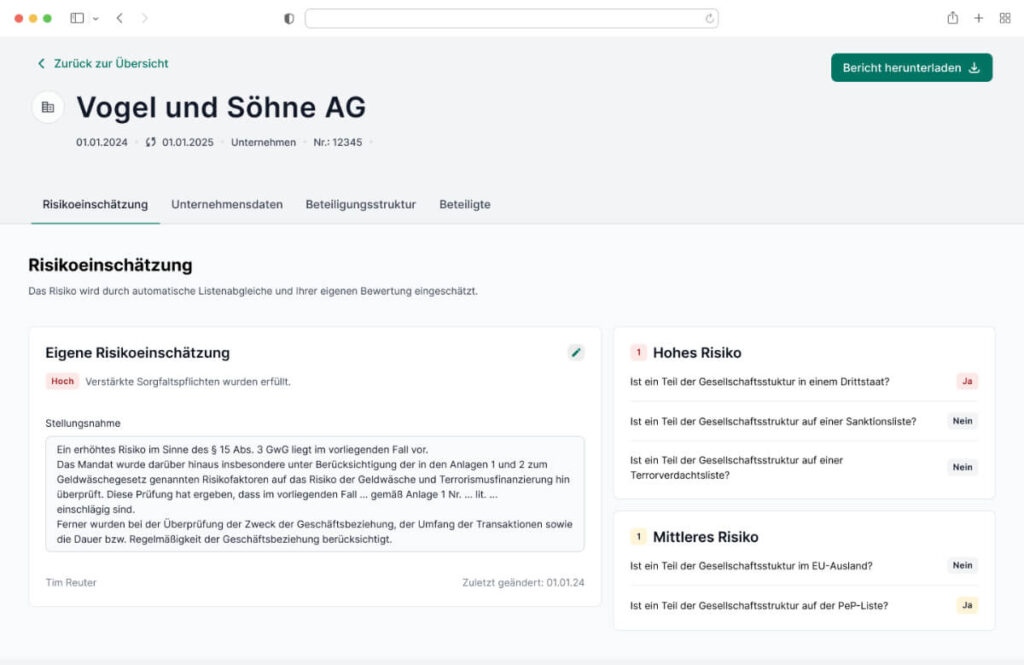
How can software support compliance processes?
Software can help companies make compliance processes more efficient and transparent. Suitable compliance software can help with documenting, monitoring and managing policies and procedures. It can also serve as a tool for training employees and enable easy reporting on compliance activities.
Under the provisions of the Money Laundering Act, the financial and non-financial sectors are required to establish efficient compliance management. Particularly in the context of the review of business partners (KYC) and the identification of the beneficial owner, the integration of software is strongly recommended. Manual checks entail an increased potential for errors. By querying and structurally processing data, it can be analyzed with little effort. Correct use of software makes it possible to compile the relevant documents in an audit-proof and time-efficient manner.