











The Money Laundering Act (GwG) is an important set of rules that companies in Germany must observe. To effectively combat money laundering, companies must understand the GwG and comply with its requirements. In this article, we take a closer look at the GwG and discuss the consequences of non-compliance.
Key Points at a Glance
- The aim of the GwG is to protect the integrity of the financial system and curb crime
- The GwG applies to all companies in Germany that deal with financial transactions – regardless of the company’s size or industry
- Companies that violate the Money Laundering Act face heavy fines
Table of Contents
The Money Laundering Act explained simply
The GwG was introduced to combat money laundering and terrorist financing. It sets out rules and procedures that companies must follow to identify and report suspicious activities. The aim of the GwG is to protect the integrity of the financial system and curb crime.
In addition, the GwG defines money laundering as the process of introducing illegal proceeds into the legal financial cycle. It includes various methods such as concealing the origin of money, mixing legal and illegal funds, and using companies for money laundering. The GwG is of great importance for all companies in Germany, regardless of their size or industry.
When was the GwG introduced in Germany?
The Money Laundering Act (GwG) is an important part of the German legal system and has a long history. It was first introduced in 1993 and has since been updated several times to address the changing threats posed by money laundering and terrorist financing. The GwG is based on international standards and guidelines, in particular the recommendations of the Financial Action Task Force (FATF), an international organization combating money laundering and terrorist financing.
What is the basis of the Money Laundering Act?
- 1st EU Anti-Money Laundering Directive 1991
- 2nd EU Anti-Money Laundering Directive 2001
- 3rd EU Anti-Money Laundering Directive 2005
- 4th EU Anti-Money Laundering Directive 2015
- 5th EU Anti-Money Laundering Directive 2018
- 6th EU Anti-Money Laundering Directive 2018
What changes to the Money Laundering Act from 2020? What applies in 2024?
- Expanded scope of application: The revised GwG extends to a broader range of businesses and professional groups. This includes cryptocurrency exchanges, art and auction houses, and virtual currency service providers. These companies must now comply with the same anti-money laundering regulations as traditional financial institutions.
- Stricter due diligence obligations: Companies and financial institutions must carry out enhanced due diligence when identifying their customers. This means they must conduct a thorough review of customer identities (KYC) to ensure they are not doing business with potentially suspicious persons. This is particularly important for transactions over 10,000 euros.
- Transparency Register: Germany has introduced a central Transparency Register. This register collects information on the beneficial owners of companies and makes it publicly accessible. This is intended to make it more difficult to carry out money laundering, as the true owners of companies can no longer operate in secrecy.
- Increased penalties: The penalties for violations of the GwG have been drastically increased. Companies and individuals who violate the regulations may be subject to substantial fines. In the case of serious violations, these fines can run into the millions, and in the worst case even a prison sentence may be imposed.
Who is affected by the Money Laundering Act? Obliged parties under the Money Laundering Act
Excerpt from the law and explanation
The GwG applies to all companies in Germany, regardless of their size or industry. It affects many different companies that deal with financial transactions. They are obliged to develop and implement internal policies and procedures to combat money laundering.
Those affected by the Money Laundering Act include, among others, the following obliged parties. You can view a list of all obliged parties in GwG Section 2 (1).
- Notaries
- Credit institutions
- Financial services institutions
- Financial companies
- certain insurance companies
- Lawyers
- Tax advisors
- Real estate agents
- Dealers in goods
How does Nect help?
Requirements of the Money Laundering Act for companies
The GwG plays an important role in business operations, as it obliges companies to take measures to prevent money laundering. This includes identifying and verifying customers, retaining business records, and reporting suspicious transactions.
Obliged parties under the Money Laundering Act (GwG) in Germany must meet various requirements in practice in order to effectively combat money laundering and terrorist financing.
Here are some of the most important requirements:
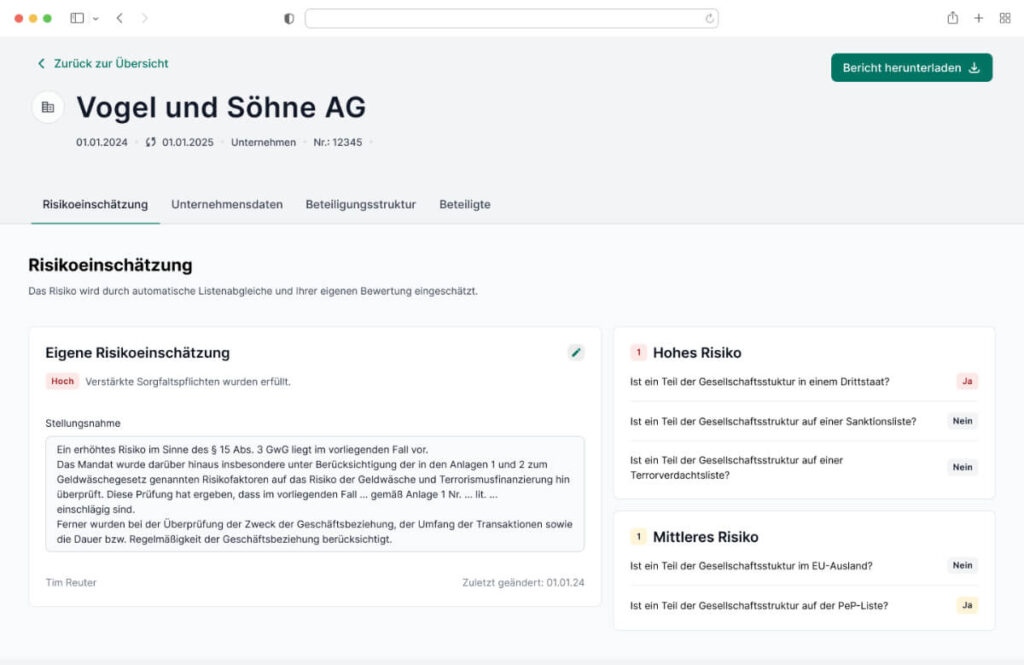
- KYC (Know Your Customer) – identification and verification of customers: Obliged parties must carefully verify and monitor the identity of their customers. This includes collecting identification documents, checking names against sanctions lists, and identifying the beneficial owner.
- Reporting suspicious transactions: If obliged parties suspect that a transaction or business relationship could be linked to money laundering or terrorist financing, they are required to report this to the competent authorities. Suspicious activity reports can be submitted via the Financial Intelligence Unit (FIU) reporting portal.
- Risk assessment and management: Obliged parties must carry out risk assessments to identify money laundering risks in their business environment. Based on this assessment, they should take appropriate measures to minimize these risks.
- Record retention: Obliged parties must retain business records and transaction documents for a certain period so that they can be inspected by the authorities if required.
- Training and awareness: Employees of obliged parties should receive regular training in money laundering prevention and detection to ensure they understand and comply with the regulations.
- Internal controls and compliance programs: Obliged parties should implement internal controls and compliance programs to ensure they meet legal requirements. This includes appointing a money laundering officer and implementing internal audit procedures.
- Transparency Register: As soon as obliged parties work with companies (legal entities), they must query the Transparency Register regarding the business partner’s beneficial owner.
Violation of the GwG – these penalties apply in the event of non-compliance
Compliance with the GwG is of great importance, as violations of the law can have serious consequences. Companies that violate the GwG may be fined and their reputation, as well as their credibility, can be significantly damaged. In addition, companies that support money laundering or terrorist financing may be prosecuted under criminal law pursuant to StGB Section 261.
In the event of violations of the Money Laundering Act (GwG), the following fines are possible:
In the case of minor violations, the fine is up to 150,000 euros (pursuant to Section 56 (1) sentence 2 GwG ).
Serious, repeated, or systematic violations may be punished with fines of up to 1 million euros (pursuant to Section 56 (3) GwG ).
In cases where the obliged parties are those pursuant to Section 2 (1) numbers 1 to 3 and 6 to 9 GwG and they are legal entities or associations of persons, a higher fine may be imposed. However, in such cases the fine may not exceed the following amounts:
- Five million euros or
- 10% of total turnover generated by the legal entity or association of persons in that financial year preceding the authority’s decision