


















Risk analysis under the AMLA (Anti-Money Laundering Act) plays a crucial role in avoiding errors and ensuring effective implementation of anti-money laundering compliance.
This article primarily refers to the “non-financial” sector.
Key Points at a Glance
- Significance of Risk Analysis under GwG: Risk analysis is a central aspect of the Anti-Money Laundering Act (GwG), which supports the prevention and combating of money laundering and terrorist financing through a risk-based approach. It requires companies to implement effective risk management that considers business activities and associated risks, and to adapt internal safeguards according to their own risk analysis and national risk analyses.
- Conducting and Adapting Risk Analysis: The risk analysis must be individually tailored to the nature and scope of the company’s business activities. It must integrate legally defined risk factors as well as insights from the National Risk Analysis to enable a comprehensive assessment and management of potential risks.
- Implementation Steps and Monitoring of Risk Analysis: The implementation of risk analysis involves several steps, beginning with an inventory and identification of risks, followed by the categorization and weighting of risks. Finally, internal security measures based on this analysis must be implemented and regularly reviewed to ensure dynamic and continuous monitoring of business relationships.
Table of Contents
Why is a Risk Analysis Important?
What is the Legal Basis for Risk Analysis?
Implementing Risk Analysis: Step by Step
Step 1: Inventory
We have listed some exemplary risk factors for potentially low risk (Annex 1) and higher risk (Annex 2). Below you will find a summary of risks for some industries according to the National Risk Analysis:
Step 2: Identify Risks
Factors for Potentially Low Risk
- Customer Risk
- Public companies listed on a stock exchange that are subject to disclosure obligations (due to stock exchange regulations or laws) ensuring appropriate transparency of the beneficial owner.
- Public administrations or companies.
- Customers residing in lower-risk geographical areas.
- Product, Service, Transaction, or Distribution Channel Risk
- Low-premium life insurance policies.
- Insurance policies for pension contracts without a surrender clause or the possibility of serving as collateral for loans.
- Pension systems and plans that deduct contributions from salaries and do not allow the transfer of rights.
- Financial products or services aimed at “financial inclusion”.
- Products where risks are controlled by restrictions or transparency (e.g., certain types of e-money).
- Geographical Risk
- Member States.
- Third countries with effective systems for preventing, detecting, and combating money laundering and terrorist financing.
- Third countries with low levels of corruption and other criminal activities.
- Third countries effectively implementing FATF recommendations.
Factors for Potentially Higher Risk
- High money laundering risk: Notaries are typically involved in real estate transactions, which represents an increased money laundering risk. Their involvement in company formations also carries risks.
- Role as public officials: As public officials, notaries act in a public-law capacity in all their activities, which requires special diligence and responsibility.
- Tension between law and professional code of conduct: Notaries must observe both the Federal Notarial Code and the Anti-Money Laundering Act, which can lead to conflicts.
- Supervision by presidents of regional courts: The supervision of notaries is not carried out by a chamber, but by the presidents of the respective regional courts.
- Special attention to trust and escrow accounts: These accounts are susceptible to money laundering, particularly in connection with cash and foreign payments.
GwG Risk Factors: Auditors
- Medium money laundering risk: Auditors have deep insights into the finances and structures of companies, which poses a potential risk for money laundering activities.
- Knowledge of the beneficial owner: Their ability to identify the true beneficial owner of a company is both a strength and a source of risk.
- Supervision by the Chamber of Public Accountants: The specific chamber for auditors plays an important role in the supervision and control of its members.
- Risk from straw man constructions: Particularly in the real estate sector, auditors should be alert to the risk posed by such constructions.
GwG Risk Factors: Lawyers
- High money laundering risk through trust accounts: Lawyers often manage trust accounts, which can be misused for money laundering.
- Supervisory function through regional chambers: In addition to representing interests, these chambers also carry out anti-money laundering supervision.
- Risk from international and cash payments: Transactions carried out in cash or from high-risk countries require increased attention.
- Involvement in real estate transactions and company formations: These areas are particularly susceptible to money laundering.
GwG Risk Factors: Tax Advisors
- Medium money laundering risk: Similar to auditors, tax advisors have detailed insights into company finances, which can be misused.
- Detection of internal irregularities: Their role enables them to identify anomalies that could indicate money laundering.
- Supervisory function through profession-specific chambers: Tax advisors are also subject to strict monitoring and regulation by their chambers.
- Importance of professional development: Continuous training is required to keep pace with changing laws and regulations
GwG Risk Factors: Real Estate Sector
- High economic significance: Real estate is an attractive investment due to high transaction volumes and value stability.
- Concealing the origin of funds: The complexity and legal structuring options of real estate transactions can be used to conceal the origin of funds.
- Anonymity in share deals: Acquiring real estate through share deals makes it possible to conceal the owner’s identity behind corporate structures, thereby preserving anonymity.
- High transparency, but risks regarding beneficial ownership: Despite the ownership structures recorded in the land register, the allocation of assets can become more difficult when beneficial ownership and formal ownership diverge.
Risk of complex - Corporate structures: Nested company networks and the use of trust constructions increase the risk of money laundering.
- Evasion mechanisms: Reformed laws could lead to a shift from purchasing to renting luxury real estate in order to launder money.
- Growing importance of rental agents: With the new regulation under the Anti-Money Laundering Directive, the role of rental agents in high-value rentals is becoming more relevant.
- Use of auctions: Foreclosure auctions are increasingly being used to acquire real estate with suspicious funds.
How does Nect help?
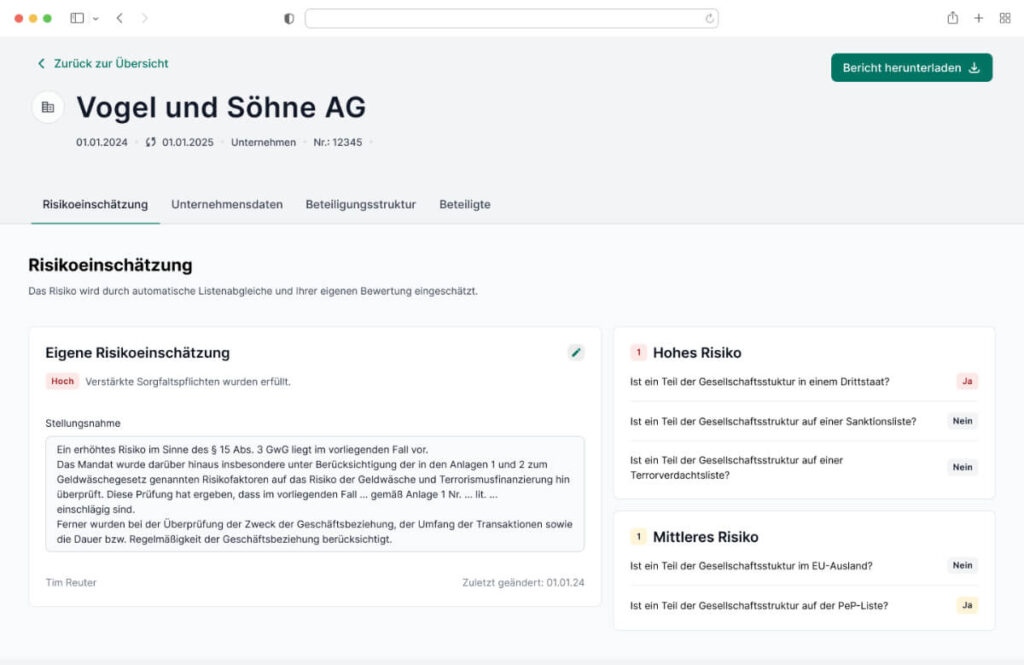
Step 3: Categorizing Risk Groups
Risks must be divided into risk groups and assessed according to their significance. This assessment is usually carried out in three stages: high, medium, and low.
However, it is possible to adjust this classification by either adding more categories or reducing them. For example, the “high” category includes risk cases that meet statutory high-risk classes or are classified as high based on internal assessments. “Medium” refers to cases that are neither classified as high nor low, and “low” refers to situations with demonstrably low risk.
Various methods can be used for risk assessment, including systems with variable or fixed weighting of risk factors. Additionally, automatic criteria for customer classification or safeguards can be defined. Deviations must be documented, and the results of national analyses on money laundering and terrorist financing must also be considered.
Step 4: Internal Safeguards
The results of the identification, categorization, and weighting of risks must be implemented within the framework of the individual internal safeguards, as these must fundamentally be derived from or correspond to the results of the risk analysis.
As in risk management generally, the more careful the approach must be in implementing individual prevention measures in each specific case, the higher the risk potential.
The internal safeguards taken must be reviewed and further developed considering the results of the risk analysis.
Step 5: Regular Monitoring
According to the legislative reasoning for § 10 (1) No. 5 GwG, continuous dynamic monitoring of the business relationship, including transactions carried out during its course, and a comparison of customer profiles with the respective transaction behavior must take place.
Dynamic monitoring here means the appropriate consideration of insights from the course of the business relationship. Continuous monitoring aims to determine whether the ongoing business relationship shows specific irregularities or relevant deviations from previous customer behavior during the processing of individual transactions.
The indicators must be defined on a company-specific basis. The results of the risk analysis must be used as a basis.