
















The beneficial owner – or UBO (ultimate beneficial owner) for short – is an important person in a company or organization. In this article, we will examine the definition of the beneficial owner in more detail and explain the legal background of the term.
Key Points at a Glance
- The beneficial owner has more than 25% of the voting rights, more than 25% of the share capital, or comparable control over a company.
Since August 1, 2021, an active reporting obligation has applied to all affected companies and organizations. - The name, date of birth, nationality, and shareholding ratios of the beneficial owners must be recorded in the Transparency Register.
Table of Contents
Definition of the beneficial owner according to the Money Laundering Act
- more than 25% of the share capital
- more than 25% of the voting rights
- comparable control as in points a. & b. over the company
- Legal entities – GmbH, UG, e.V., AG, etc.
- Registered partnerships – GbR, OHG, KG etc.
Legal background & meaning of the term
What special features need to be considered for stock corporations?
If the contracting party is a listed stock corporation (AG), the determination of beneficial owners can be waived under certain conditions.
As soon as the contractual partner is a non-listed stock corporation (AG), the beneficial owner must be determined.
The following applies to entry in the Transparency Register for listed companies:
“The Money Laundering Act Section 20 (1) sentence 1 GwG contains no exemption for companies that are listed on an organized market according to Section 2 (11) WpHG listed.” – Transparency Register FAQ
Who is not a beneficial owner and why?
What is a fictitious beneficial owner?
Example of a fictitious beneficial owner
Indirect participation: When does indirect control lie with the beneficial owner?
- it has the right to appoint or dismiss the majority of the members of the administrative, management, or supervisory body determining the financial and business policy of another company, and it is simultaneously a shareholder (Section 290 (2) No. 2 HGB),
- it has the right to determine the financial and business policy based on a control agreement concluded with another company or based on a provision in the articles of association of the other company (Section 290 (2) No. 3 HGB), or
- from an economic perspective, it bears the majority of the risks and rewards of a company that serves to achieve a narrowly limited and precisely defined objective of the parent company (special purpose entity), cf. Section 290 (2) No. 4 HGB.
What applies to the beneficial owner of a GmbH?
The principles mentioned above apply equally to the beneficial owner of a GmbH (limited liability company). If several persons each hold a share of more than 25%, the GmbH accordingly has several beneficial owners. In cases of complex participation structures – also referred to as multi-level participation – and corporate interconnections, it is of decisive importance whether the natural person behind the intermediate company can exert actual control at the second or a higher level.
Example of a multi-level participation

Who is obliged to determine the beneficial owner?
- Lawyers
- Tax advisors
- Notaries
- Banks
- Real estate agents
- Dealers in goods
- Asset management companies
- Auditors
- Insurers
Determination / identification of the beneficial owner according to the Money Laundering Act
Identification process
The first step should be to consult the Transparency Register. Companies must state the beneficial owner there. An extract from the respective company should provide information about the beneficial owners of the counterpart.
The contractual partner must provide the GwG-obligated company, in accordance with Section 11 (6) GwG documents for identifying the beneficial owner.
Another process for identifying the beneficial owner involves reviewing documents such as articles of association, ownership documents, and register extracts. It may also be necessary to obtain information from the persons involved themselves.
If, after a thorough investigation of the beneficial owners, no clear identification is possible, the managing director of the GmbH is considered the beneficial owner.
In Germany, the identification of the beneficial owner is mandatory according to the Money Laundering Act (GwG). Companies are obliged to determine and document the identity of the beneficial owner in order to prevent money laundering and other illegal activities.
What are the challenges and solutions in identification?
Identifying the beneficial owner can present some challenges. Sometimes information is not easily available or the persons involved are uncooperative. It is important to find solutions to overcome these obstacles. This can be achieved, for example, through cooperation with authorities or the use of technological solutions for data analysis and verification.
How does Nect help?
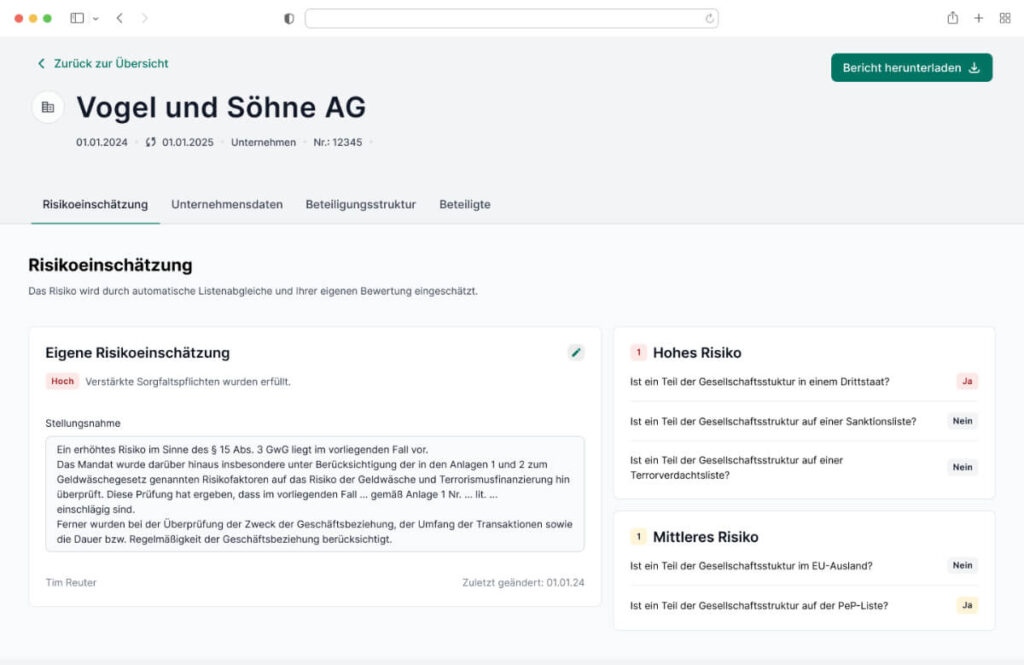
Transparency Register: When do I have to report the beneficial owners?
Excursus - What is the Transparency Register?
“New” regulation as of August 1, 2021 - Active reporting obligation
Until August 1, 2021, entry in the Transparency Register was not required if the information about the beneficial owners was already electronically verifiable from the documents listed in Section 22 (1) of the Money Laundering Act (GwG). These include documents from the commercial register, partnership register, cooperative register, register of associations, or company register. In this case, the so-called “reporting fiction” according to Section 22 (2) GwG could be applied.
However, this regulation on automatic reporting lapsed on August 1, 2021, with the entry into force of the Transparency Register and Financial Information Act (TraFinG).
From now on, companies and organizations that previously refrained from automatic reporting must immediately record and report their beneficial owners separately in the Transparency Register (active reporting obligation).